SD 1.5 vs SD 2.1 vs SDXL on iPhone: Which Stable Diffusion model works locally?
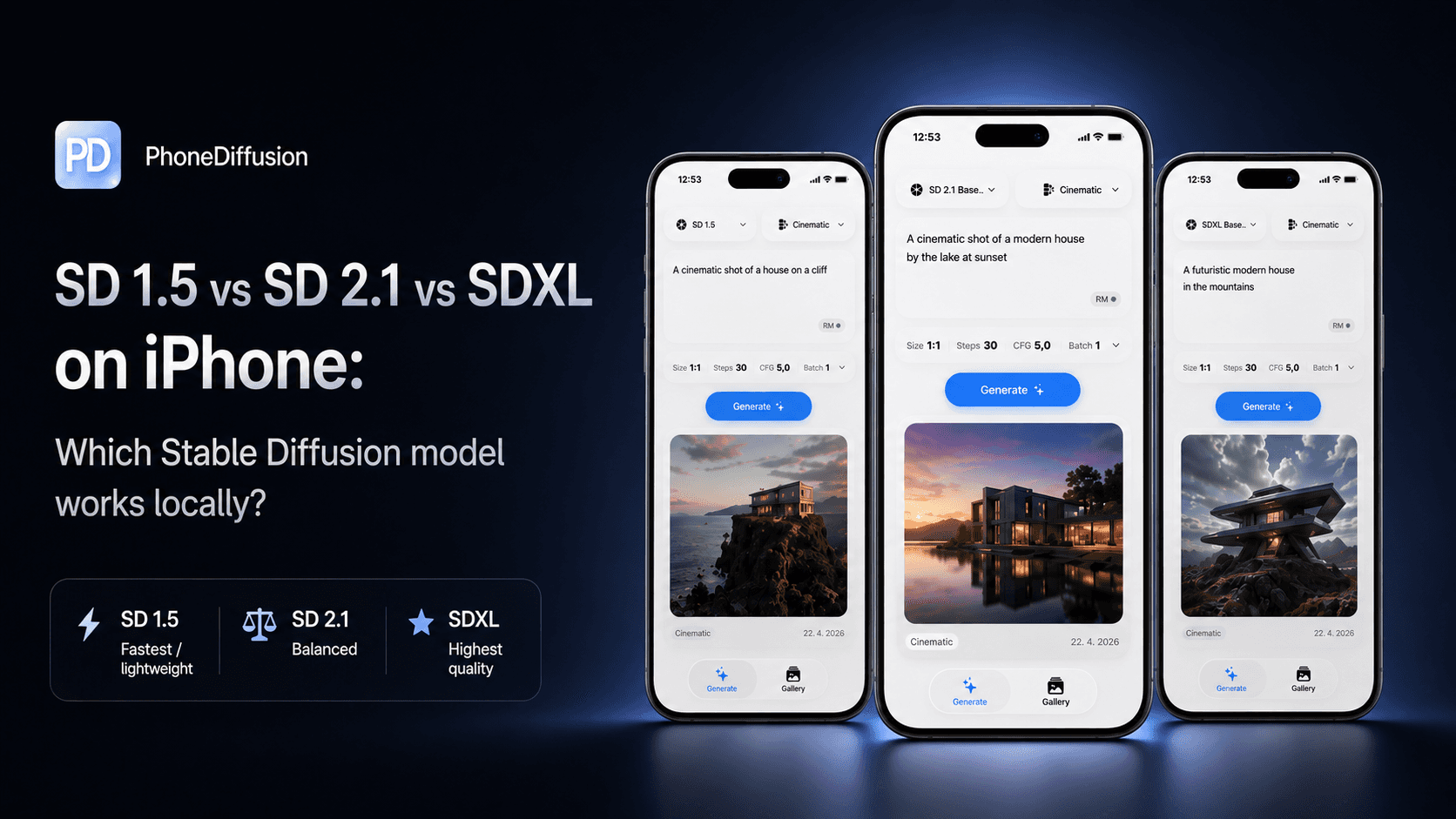
If you care about Stable Diffusion on iPhone, asking which model is "best" is the wrong starting point. On phone, the better question is which model family matches the workflow you actually want: faster local iteration, a practical middle ground, or a higher visual ceiling on newer hardware.
The short version is simple. SD 1.5 is still the easiest way to keep a local workflow light and flexible. SD 2.1 Base makes sense as a pragmatic 512-class middle ground. SDXL is the family to reach for when stronger hardware and higher output ambition matter more than setup size and iteration speed.
If you want to run Stable Diffusion directly on your iPhone and generate AI images offline, check out PhoneDiffusion.
The short answer
Choose SD 1.5 if speed, style ecosystem, and quicker local iteration matter most.
Choose SD 2.1 Base if you want a 512-class model that still fits a serious local mobile workflow without jumping straight to SDXL cost.
Choose SDXL if you are on stronger iPhone hardware and care more about output ambition than fast iteration.
Do not assume the best desktop answer is automatically the best iPhone answer.
Why model choice feels different on iPhone than on desktop
On desktop, users can often brute-force around a heavier model with more VRAM, bigger cooling headroom, and a stack of supporting tools. On iPhone, model family changes much more than image taste. It changes setup size, generation time, heat, device fit, and how patient the workflow feels.
Apple’s public Core ML releases make that split visible. Its iPhone-ready Stable Diffusion v1.5 and 2.1 Base builds are 512x512-class models, while the iPhone-oriented SDXL release is a separate 768x768 build with more aggressive iOS-focused compression. That alone tells you something important: on iPhone, model choice is not just a quality debate. It is a product and workflow decision.
SD 1.5: still the easiest way to keep a local workflow nimble
Apple’s public Core ML v1.5 release is a 6-bit palettized build for Apple Silicon, and the original v1.5 model card is still rooted in 512x512 training. That smaller starting point is one reason SD 1.5 still matters for mobile-minded users.
The bigger reason is ecosystem. Outside Apple-specific deployment, current comparison guides and community discussion still treat SD 1.5 as the family with the deepest backlog of checkpoints, LoRAs, and niche styles. If you care about anime styles, older fine-tunes, or fast prompt exploration, that matters more than the base model’s age.
On iPhone, SD 1.5 makes the most sense when your goal is:
fast drafting and iteration
broader style experimentation
a lighter local workflow
less patience for long per-image wait times
The tradeoff is also clear. The official model card still flags weak legible text, weaker compositional tasks, and imperfect faces. So SD 1.5 is still a smart iPhone choice, but not because it has the highest ceiling. It is useful because it is the easiest family to keep flexible.
SD 2.1 Base: the quiet middle ground
Stable Diffusion 2.1 Base rarely gets the same attention as SD 1.5 or SDXL, but it matters more on iPhone than it does in generic desktop debates.
Apple’s public Core ML benchmark table uses Stable Diffusion 2.1 Base at 512x512 as a reference model for iPhone-class hardware, and Apple also publishes ready-made Core ML 2.1 Base weights for Apple Silicon. The official 2.1 Base model card still warns about familiar limitations: poor legible text, imperfect people, and harder compositional prompts. It is not a magic answer.
But for local iPhone workflows, 2.1 Base still makes sense as a product choice. It gives you a more modern 512-class base model without forcing the full setup, resolution, and runtime cost profile of SDXL.
That middle-ground role is partly an inference from the public Apple support matrix and partly supported by PhoneDiffusion’s current production direction, which centers on sd15-base, sd21-base, and sdxl-base-1.0 rather than a one-model story.
On iPhone, SD 2.1 Base makes the most sense when you want:
a practical local baseline
something lighter than SDXL
a model family that still fits a serious on-device product lane
If SD 1.5 is the fast-and-flexible option and SDXL is the quality-first option, SD 2.1 Base is the sensible middle.
SDXL: best when output ambition matters more than friction
SDXL earns its reputation. The SDXL model card describes a larger system with two text encoders, and Stability AI’s published evaluation notes show SDXL outperforming Stable Diffusion 1.5 and 2.1 in user preference.
But that higher ceiling comes with a different mobile profile.
Apple’s iPhone-oriented SDXL release is not the same thing as running desktop SDXL unchanged. The public iOS build uses a 768x768 target, 4.04-bit mixed-bit palettization, and an iOS-specific Core ML packaging path to make the model viable on Apple devices at all.
Apple’s published benchmark table makes the workflow tradeoff concrete. In Apple and Hugging Face’s iOS 17-era reference runs, an iPhone 14 Pro Max took 7.9 seconds for Stable Diffusion 2.1 Base at 512x512 and 77 seconds for the iOS SDXL build at 768x768, both at 20 steps. Those are not universal promises, but they are a useful public reference for how dramatic the mobile gap can be across model families.
On iPhone, SDXL makes the most sense when you care about:
better composition and higher output ambition
higher-resolution local output
fewer but more deliberate generations
newer hardware that can justify the extra weight
The downside is exactly what users feel in practice: bigger setup cost, slower iteration, more heat, and less tolerance for a casual "try 40 prompts in a row" workflow.
Which model family fits which iPhone workflow?
Use SD 1.5 when you want the fastest path to local experimentation and the broadest style ecosystem.
Use SD 2.1 Base when you want a balanced 512-class local workflow that feels more serious than an older default without taking on full SDXL cost.
Use SDXL when you care more about output ambition than iteration speed and you are comfortable with a heavier local workflow.
Many serious local users end up thinking in exactly these terms: smaller model families for faster exploration, heavier ones for more deliberate output. On iPhone, that pattern matters even more because the cost of a heavier model is impossible to ignore.
How PhoneDiffusion fits this topic
PhoneDiffusion’s current repo direction is centered on sd15-base, sd21-base, and sdxl-base-1.0. That is the right public story, because it reflects an honest mobile reality: different local workflows call for different model families.
PhoneDiffusion does not need to win by pretending one model is universally best. It can win by being clear about the tradeoff:
smaller and faster is a real user need
a middle-ground local model still matters
higher-quality local generation is valuable, but it is not free
That is a better framing for technical users and prosumers than generic AI-app marketing.
If you want to run Stable Diffusion directly on your iPhone and generate AI images offline, check out PhoneDiffusion.
FAQ
Is SDXL always better than SD 1.5 on iPhone?
No. SDXL has the higher ceiling, but on iPhone the cost in setup, time, and heat is also much higher. If fast iteration matters more than maximum output ambition, SD 1.5 can still be the better fit.
Why does SD 1.5 still matter in 2026?
Because local workflows still care about speed, control, and ecosystem depth, not just headline quality. A smaller model family is often the most practical way to keep local generation usable on phone-class hardware.
Is SD 2.1 Base obsolete?
No. For local iPhone use, it still makes sense as a practical middle ground between older 1.5-era flexibility and full SDXL cost. That middle-ground framing is an inference from public Core ML support and current product reality, not a claim that 2.1 is universally superior.
Can one iPhone app support multiple model families well?
Yes, but users should not expect every phone to feel the same with every model family. Public Apple benchmarks and the current iPhone app landscape both make that clear.
Final takeaway
The best Stable Diffusion model on iPhone is not a universal best.
SD 1.5 remains the quickest way to keep a local workflow light. SD 2.1 Base is the quiet middle ground that still makes sense on mobile. SDXL is what you reach for when you want a higher visual ceiling and have hardware that can carry it.
That is exactly why PhoneDiffusion’s current direction makes sense. The right iPhone image-generation product does not flatten model choice into a slogan. It helps users choose the local workflow that actually fits them.